"...a fiery flame"


“…a fiery flame
lasting for three days,
emerging from the earth.
And on the fourth day thereafter,
a great dragon came flying out,
which rose very high into the sky,
to the great terror of many."
collaboration with Elena Khurtova
Commissioned by VHDG, Leeuwarden for the exhibition ‘Grensverleggers’
Curated by Roísín Douglas
In 1949 the airport Leeuwarden became a dedicated military airbase. This airbase hosts F35 fighter planes, which recently have come to negative public attention because of the supply of Dutch manufactured F35 parts for planes that facilitate the genocide which Israel is committing in Palestine. Next to the F35 fighter planes also General Atomics MQ-9 Reaper drones are stationed here. MQ-9 refers to the first so called “hunter-killer UAV” designed for long-endurance, high-altitude surveillance flights. The airbase is controversial with the residents of Leeuwarden because of the contaminating effect which the frequent the flights of military have on the direct surrounding of the airfield. This contamination includes noise pollution, and less easy to perceive directly, the pollution of water and soil. It is not advisable to drink water or eat fish or vegetable produce from anywhere close to the airbase due to heavy PFAS pollution. The noise of the frequent flight exercises leaves residents sleepless and drives away wildlife. The exercise of armed combat is turning Leeuwarden airbase into a place that is hostile towards life.
Curiously the Dutch Airforce is using the heraldic emblem of a dragon to represent itself in Leeuwarden. This image is chosen to project a message about the protection of the Frisian region. The public is supposed to imagine that ‘flying dragons' rise in the air to offer protection: in form of fighter planes. The accompanying motto 'amicis inimicis promptus' (ready for friend and foe) provides a matching, mythological sounding, dualistic worldview where one has to fight either for or against one another, important is that one is ready to fight.
On closer examination of the historical position of dragons, as represented in Frisian Chronicles, they are mentioned rather as a source of terror than protection.
The historian Ocko Scharlensis (a rumoured pseudonym for Andreas Cornelius, an author and organist from Harlingen) reports that:
a fiery flame
lasting for three days,
emerging from the earth.
And on the fourth day thereafter,
a great dragon came flying out,
which rose very high into the sky,
to the great terror of many.
This 16th century text goes on to associate the dragon that emerged from the earth with “great death and pestilence”, occurrences that are usually observed in reality as a result of armed conflict. In such light, the dragon is an interesting symbolic choice by the Dutch Airforce.
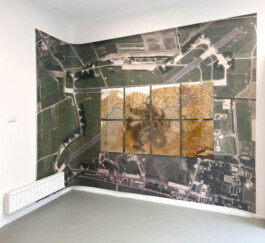
This work investigates through the symbolic meaning of the dragon the impact which aircraft weapons have on lifeforms in their milieu of existence. Using contaminated soil from close to the airbase to create prints of the images which are chosen by the Airforce to represent itself, they visualise toxic effects that exist as well in mythological contexts, as in very factual realms of reality. Soilchromatographic prints show substances that are contained in the ground. This experimental photochemical process causes nutrients and toxins to imprint themselves on paper as formations of patterns, textures and earthy colour schemes ranging from orange to purple and brown.
collaboration with
Elena Khurtova
YEAR
2025
MATERIALS
spatial installation including aerial photograph and paper prints that are created with a custom photochemical process
DIMENSIONS
variable
SUPPORTED BY:
Mondriaanfonds
"...a fiery flame"
“…a fiery flame
lasting for three days,
emerging from the earth.
And on the fourth day thereafter,
a great dragon came flying out,
which rose very high into the sky,
to the great terror of many."
collaboration with Elena Khurtova
Commissioned by VHDG, Leeuwarden for the exhibition ‘Grensverleggers’
Curated by Roísín Douglas
In 1949 the airport Leeuwarden became a dedicated military airbase. This airbase hosts F35 fighter planes, which recently have come to negative public attention because of the supply of Dutch manufactured F35 parts for planes that facilitate the genocide which Israel is committing in Palestine. Next to the F35 fighter planes also General Atomics MQ-9 Reaper drones are stationed here. MQ-9 refers to the first so called “hunter-killer UAV” designed for long-endurance, high-altitude surveillance flights. The airbase is controversial with the residents of Leeuwarden because of the contaminating effect which the frequent the flights of military have on the direct surrounding of the airfield. This contamination includes noise pollution, and less easy to perceive directly, the pollution of water and soil. It is not advisable to drink water or eat fish or vegetable produce from anywhere close to the airbase due to heavy PFAS pollution. The noise of the frequent flight exercises leaves residents sleepless and drives away wildlife. The exercise of armed combat is turning Leeuwarden airbase into a place that is hostile towards life.
Curiously the Dutch Airforce is using the heraldic emblem of a dragon to represent itself in Leeuwarden. This image is chosen to project a message about the protection of the Frisian region. The public is supposed to imagine that ‘flying dragons' rise in the air to offer protection: in form of fighter planes. The accompanying motto 'amicis inimicis promptus' (ready for friend and foe) provides a matching, mythological sounding, dualistic worldview where one has to fight either for or against one another, important is that one is ready to fight.
On closer examination of the historical position of dragons, as represented in Frisian Chronicles, they are mentioned rather as a source of terror than protection.
The historian Ocko Scharlensis (a rumoured pseudonym for Andreas Cornelius, an author and organist from Harlingen) reports that:
a fiery flame
lasting for three days,
emerging from the earth.
And on the fourth day thereafter,
a great dragon came flying out,
which rose very high into the sky,
to the great terror of many.
This 16th century text goes on to associate the dragon that emerged from the earth with “great death and pestilence”, occurrences that are usually observed in reality as a result of armed conflict. In such light, the dragon is an interesting symbolic choice by the Dutch Airforce.
This work investigates through the symbolic meaning of the dragon the impact which aircraft weapons have on lifeforms in their milieu of existence. Using contaminated soil from close to the airbase to create prints of the images which are chosen by the Airforce to represent itself, they visualise toxic effects that exist as well in mythological contexts, as in very factual realms of reality. Soilchromatographic prints show substances that are contained in the ground. This experimental photochemical process causes nutrients and toxins to imprint themselves on paper as formations of patterns, textures and earthy colour schemes ranging from orange to purple and brown.
collaboration with
Elena Khurtova
YEAR
2025
MATERIALS
spatial installation including aerial photograph and paper prints that are created with a custom photochemical process
DIMENSIONS
variable
SUPPORTED BY:
Mondriaanfonds